D&D - Dices and Dungeons was a 4-person project made in Unity in 48 hours for GMTK Game Jam 2022, under the jam’s theme “Roll of the Dice” - with over 6,000 entries, this was the largest game jam in itch.io’s history at the time. For this project my contributions were the dice inheritance/polymorphism system, the wave spawning system, and the enemies’ steering behaviour (seek + separation).
Concept
Dices and Dungeons is a first-person wave-survival game where your only weapons are dice. With different types and different faces to roll - the “power level” - throw them at enemies and try to survive six increasingly difficult waves to win.
Dice System
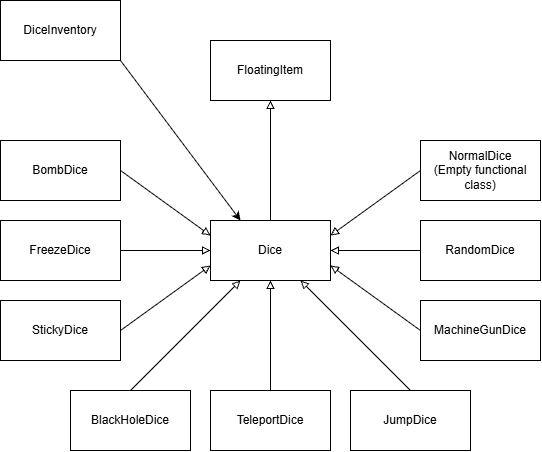
Since it was a low time jam, the dice system needed to be easy to tweak if new dice ideas appeared at the last minute. As such, a good inheritance and polymorphism structure was needed to make expansion easy. To that end, a FloatingItem base class handles nothing but the idle bob-and-spin every pickup does, and the Dice class builds on top of it to add the rolled value, the throw impulse, and collision resolution against anything implementing IHittable. From there, 9 dice types - BombDice, FreezeDice, StickyDice, BlackHoleDice, TeleportDice, JumpDice, MachineGunDice, RandomDice, and NormalDice - each override a single method to add their own effect, so adding another die never means touching the throw or collision code.
Complementing it, DicesInventory holds a pool of dice prefabs and only ever depends on the shared Dice type - it spawns whichever one is equipped and reads its sprite and effect straight off that base class, without needing to know which concrete dice it’s holding or its specific behaviour.
Enemy & Wave System
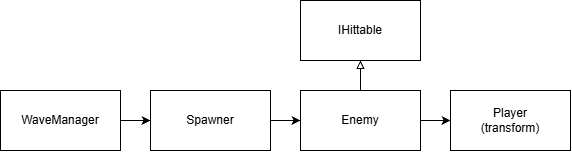
Despite only having a single enemy type, we needed a wave system to easily test, tweak and balance. A WaveManager steps through six hand-tuned waves, each defining an enemy count, an HP range, and how many spawners are active. Spawners are kept deliberately independent - WaveManager just tells one “spawn an enemy with this much HP” and moves on, so the spawners have no knowledge of wave difficulty or pacing.
On the enemy logic, rather than just walking straight at the player, each enemy blends two forces every frame: a pull toward the player, and a separation force pushing it away from nearby enemies - a small flocking behaviour that keeps enemies from stacking on top of each other once a wave gets crowded.
Key Implementation Concepts
- Using inheritance and an interface (IHittable) to decouple the dice from anything they can hit
- Structuring one-effect-per-subclass dice types so new weapons don’t require touching shared code
- Basic steering (seek + separation) for enemy movement
- Deliberately independent spawners driven by a central WaveManager